
reading time: 21 minute(s)

The Q2 2026 IFTA filing season is now underway. Motor carriers operating in multiple IFTA jurisdictions must report their mileage and fuel purchases for the period April 1 through June 30, 2026, and file their quarterly return by July 31, 2026.
Along with preparing your return, it’s important to review the latest fuel tax rates. For Q2 2026, only five jurisdictions introduced fuel tax rate changes, while the remaining jurisdictions retained their previous rates.
This article covers the Q2 filing deadline, highlights the latest fuel tax updates, and shares practical tips to help you file your IFTA return accurately and on time using TruckLogics.
In This Guide
Information You’ll Need to File Your Q2 2026 IFTA Return
Your second-quarter return covers all qualified vehicle travel and fuel purchases made between April 1, 2026 and June 30, 2026, across the 48 contiguous U.S. states and 10 Canadian provinces. To file, you’ll need:
- Total miles traveled during the quarter
- Taxable miles traveled in each jurisdiction
- Total gallons of fuel purchased
- Fuel receipts with complete purchase details
- IFTA account and license information
- Distance records for every qualified vehicle
Q2 2026 IFTA Filing Deadline
| Quarter | Reporting Period | Filing Deadline |
|---|---|---|
| Q2 2026 | April 1 – June 30, 2026 | July 31, 2026 |
Failing to file your IFTA return by the deadline may result in penalties, interest, or both, depending on your base jurisdiction. Filing early also gives you enough time to review mileage records, verify fuel purchases, and correct any discrepancies before submission.
What’s New for Q2 2026?
To identify the latest fuel tax updates, we compared the official Q1 2026 and Q2 2026 IFTA fuel tax matrices across all participating jurisdictions.
Q2 2026 Fuel Tax Update at a Glance
| Summary | Count |
|---|---|
| Total IFTA Jurisdictions Reviewed | 61 |
| Jurisdictions with Fuel Tax Rate Changes | 5 |
| Jurisdictions with No Actual Fuel Tax Changes | 56 |
While the Q2 tax matrix contains several minor rate differences, most are due to USD/CAD currency conversion updates rather than changes to fuel tax laws. The vast majority of jurisdictions maintained their existing fuel tax rates.
For Q2 2026, only the following jurisdictions introduced actual fuel tax rate changes:
- Florida
- Georgia
- Indiana
- Massachusetts
- New York
The remaining 56 jurisdictions retained their Q1 2026 fuel tax rates.
2026 Q2 IFTA Tax Rate Changes You Need to Know
| Jurisdiction | Fuel Types Affected | Q1 2026 Rate | Q2 2026 Rate | Change |
|---|---|---|---|---|
| Florida | Gasoline, Gasohol | 0.4040 | 0.4110 | +0.0070 |
| Florida | Special Diesel, Biodiesel | 0.4027 | 0.4097 | +0.0070 |
| Georgia | Gasoline, Gasohol, Propane, LNG, CNG, Ethanol, Methanol, E-85, M-85, A55 | 0.3310 | 0.3330 | +0.0020 |
| Georgia | Special Diesel, Biodiesel | 0.3710 | 0.3730 | +0.0020 |
| Indiana | Gasoline, Gasohol, Ethanol, Methanol, E-85, M-85, A55 | 0.3600 | 0.3700 | +0.0100 |
| Indiana | Special Diesel, LNG, CNG, Biodiesel | 0.6100 | 0.6300 | +0.0200 |
| Massachusetts | Propane, LNG, CNG | 0.1970 | 0.2500 | +0.0530 (+26.9%) |
| New York | Gasoline, Gasohol, Ethanol, Methanol, M-85, A55 | 0.3980 | 0.3970 | −0.0010 |
| New York | Propane | 0.2400 | 0.2390 | −0.0010 |
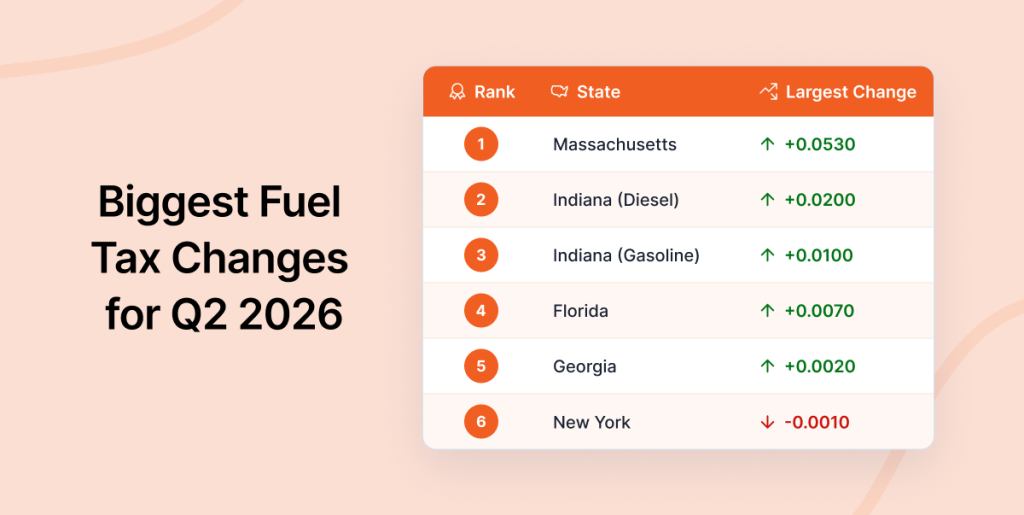
Although 61 IFTA jurisdictions participate in the agreement, only five jurisdictions introduced actual fuel tax rate changes for Q2 2026. The remaining jurisdictions maintained the same fuel tax rates as the previous quarter.
The table below summarizes all legislative fuel tax rate updates for Q2 2026.
- Massachusetts recorded the largest fuel tax increase this quarter, with a 26.9% increase for propane, LNG, and CNG.
- Indiana introduced the broadest update, affecting both gasoline and diesel-related fuel categories.
- Florida and Georgia implemented modest increases across multiple fuel types.
- New York was the only jurisdiction to reduce its fuel tax rates during Q2 2026.
For a complete list of fuel tax rates by jurisdiction and fuel type, refer to the Q2 2026 IFTA Fuel Tax Rate Chart.
👉 View the Complete Q2 2026 IFTA Fuel Tax Rate Chart
How These Changes May Affect Your Fleet
Even small tax rate adjustments can impact your quarterly IFTA calculations, especially if your fleet logs substantial mileage in affected jurisdictions.
Before filing your Q2 return, be sure to:
- Review your jurisdiction-wise mileage.
- Verify all fuel purchase receipts.
- Use the updated Q2 fuel tax rates.
- Double-check fuel type classifications.
- Keep supporting records in case of an audit.
Using outdated rates can lead to incorrect tax calculations and may require amendments later. Reliable IFTA reporting software updates tax rates automatically for every jurisdiction, so your calculations always reflect the current quarter.
Filing Tips for Your Q2 2026 IFTA Return
Accurate recordkeeping and timely preparation can help simplify your Q2 IFTA filing, reduce errors, and support compliance. Keep these best practices in mind before you file:
1. Track Mileage by Jurisdiction
Maintain accurate records of the miles traveled in each IFTA member jurisdiction throughout the quarter. Using GPS-based mileage tracking or electronic logging devices (ELDs) can simplify recordkeeping and improve accuracy.
2. Keep Fuel Purchase Receipts Organized
Retain all fuel receipts and invoices, ensuring they include the purchase date, seller information, fuel type, number of gallons or liters purchased, and the jurisdiction where the purchase was made. Organized fuel records make reconciliation much easier.
3. Match Fuel Purchases to the Correct Jurisdiction
Verify that each fuel purchase is reported under the jurisdiction where it actually occurred. Incorrect jurisdiction reporting can result in inaccurate tax calculations and potential audit issues.
4. Review the Updated Q2 2026 Fuel Tax Rates
Although most jurisdictions maintained the same tax rates this quarter, Florida, Georgia, Indiana, Massachusetts, and New York introduced rate changes. Confirm that your calculations use the updated Q2 rates before filing.
5. Verify Your Total Mileage and Fuel Records
Before submitting your return, reconcile your trip mileage, odometer readings, and fuel purchase records. Reviewing these records together helps identify missing trips, duplicate entries, or reporting discrepancies.
6. Retain Supporting Documentation
Keep copies of your mileage reports, fuel receipts, trip sheets, invoices, and filed IFTA returns. These records should be readily available in case of an audit or future reference.
Penalties for Missing the Q2 IFTA Deadline
Filing after July 31, 2026 comes with real costs:
- A penalty of $50 or 10% of the total tax due, whichever is greater
- Interest charges on any unpaid tax balance
- Possible suspension of your IFTA license for repeated late filing
Simplify Q2 IFTA Filing with TruckLogics
Preparing your quarterly IFTA return doesn’t have to be time-consuming.
With TruckLogics, you can:
- Automatically track mileage by jurisdiction.
- Record fuel purchases in one place.
- Calculate IFTA fuel taxes accurately.
- Generate IFTA-ready reports in minutes.
- Stay organized and file before the deadline with confidence.
Whether you manage a single truck or an entire fleet, TruckLogics helps simplify every step of the IFTA reporting process.
Final Thoughts
With the Q2 2026 IFTA filing deadline approaching on July 31, 2026, now is the time to review your mileage records, fuel purchases, and applicable tax rates. While only five jurisdictions updated their fuel tax rates this quarter, using the correct rates is essential for accurate reporting and compliance.
Ready to File Your Q2 2026 IFTA Return?
TruckLogics makes it easy to calculate fuel taxes, generate IFTA reports, and file your Q2 return with confidence—all from one place.
File Your Q2 IFTA Return →
Leave a Comment